

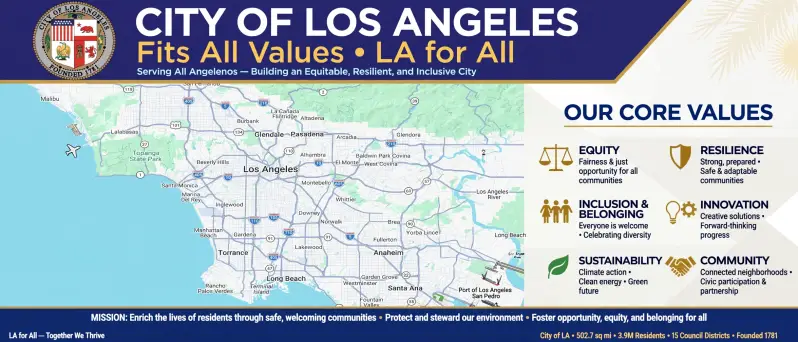
Equity: Fairness and Just Opportunity for All
Housing crisis and homelessness: The shortage is most severe for extremely low income households, with only about 21 affordable units available per 100 households in that group. Median rents remain above $2,800/month in many neighborhoods, pushing working families toward overcrowding, long commutes, or displacement. In 2025, the countywide homelessness total reached around 73,040 people, including 45,194 within the City of LA, a 3.4% year over year increase.
Income inequality and cost of living: High housing, childcare, healthcare, and transportation costs hit lower income Angelenos hardest, even when they work full time. The result is a two tier city where opportunity depends heavily on zip code, access to a car, and access to stable housing.
Environmental injustice: Low income neighborhoods and communities of color face higher exposure to freeway pollution, industrial sites, heat islands, and wildfire smoke, while having less tree canopy, park space, and cooling infrastructure.
Resilience: Strong, Prepared, Safe and Adaptable
Wildfires: The January 2025 fires burned more than 12,000 structures and forced more than 150,000 residents to evacuate. The Palisades Fire destroyed more than 6,000 structures and evacuated more than 23,000 people, while the Eaton Fire destroyed more than 9,000 structures and heavily impacted Altadena.
Earthquake risk: LA sits on the San Andreas fault system and a network of smaller faults. A major quake threatens older buildings, bridges, water pipes, and gas lines that still need seismic retrofitting. Many residents still lack emergency kits, go bags, or a family communication plan.
Infrastructure strain: Aging roads, bridges, water mains, and power lines are stressed by heatwaves, wildfires, and heavy use. Heatwaves and wildfire strain on the power grid raise blackout risk, especially for older adults, people with medical equipment, and renters without backup cooling.
Inclusion and Belonging: Everyone Is Welcome, Celebrating Diversity
Displacement after disasters: Wildfire survivors, renters, immigrants, and unhoused neighbors face the highest risk of being pushed out permanently after a fire, rent hike, or redevelopment. Rebuilding costs and insurance gaps make return harder for those with the fewest resources.
Access gaps: Language access, disability access, digital access, and access to city services still vary widely by neighborhood. People without stable addresses, IDs, or internet access have a harder time reaching benefits, housing help, and emergency alerts.
Mental health and trauma: About 30% of LA County adults reported experiencing wildfire in the past 2 years, and many reported mental health impacts tied to evacuation, loss, smoke, and ongoing uncertainty.
Innovation: Creative Solutions, Forward Thinking Progress
Traffic congestion and transportation equity: LA has among the worst traffic in the U.S., with drivers losing more than 90 hours per year to congestion. Car dependent design limits access for people who cannot drive, cannot afford a car, or live far from jobs and clinics. Transit gaps, fare costs, and reliability issues worsen equity challenges.
Housing innovation bottleneck: Permitting delays, high construction costs, neighborhood opposition, and limited land for affordable building slow down solutions like adaptive reuse, modular housing, accessory dwelling units, and mixed income developments.
Emergency communication: Alert systems, evacuation routes, and real time air quality data improved after 2025, but gaps remain during fast moving fires, power outages, and overnight evacuations.
Sustainability: Climate Action, Clean Energy, Green Future
Water scarcity and drought: LA depends on imported water for about 60% of its supply from the Colorado River and the State Water Project. Drought and reduced Sierra Nevada snowpack strain reservoirs for 3.9M residents. Conservation has helped, but long term supply still depends on recycling, stormwater capture, groundwater replenishment, and reducing outdoor water use.
Air pollution and toxic exposure: The January 2025 fires exposed an estimated 7 million people to lead pollution at levels far above normal, plus arsenic, copper, and other toxics released from burning homes, cars, and infrastructure. LA County also has a high share of adults harmed by wildfire smoke health impacts, including asthma flare ups, heart strain, and respiratory illness.
Extreme heat: More than half of Californians reported experiencing extreme heatwaves, and many reduce air conditioning use due to cost, raising health risk. Lack of shade, cool centers, and tree cover makes heat deadlier in dense, paved neighborhoods.
Community: Connected Neighborhoods, Civic Participation and Partnership
Neighborhood fragmentation: Long commutes, housing instability, and disaster displacement weaken neighborhood ties. When people move frequently, local networks, schools, small businesses, and mutual aid groups lose continuity.
Public safety and trust: Residents want safe streets, parks, and transit, but approaches to policing, homelessness outreach, and encampment response remain contested. Without consistent services, housing placements, and mental health support, visible homelessness and public safety concerns feed each other.
Civic participation gaps: Renters, youth, immigrants, and unhoused residents are less likely to be heard in planning decisions, even though those decisions shape housing, transit, and climate resilience in their neighborhoods.
Root Causes
Climate change: Hotter, drier conditions, longer fire seasons, and more intense heatwaves
Housing shortage: Decades of underbuilding, especially affordable homes near jobs and transit
Income inequality: Wages not keeping pace with housing, healthcare, and transportation costs
Rapid growth and sprawl: Car dependent development that increases emissions, traffic, and infrastructure costs
Historic underinvestment: Less investment in tree canopy, transit, water infrastructure, and seismic retrofits in lower income areas
Impacts
Displacement: People priced out, evacuated, or unable to return after fires
Public health risk: Smoke, heat, lead, and poor air quality driving respiratory, heart, and mental health impacts
Economic hardship: Lost homes, jobs, small businesses, and savings after disasters and rent increases
Environmental injustice: Unequal exposure to pollution, heat, and fire risk
Community trauma: Repeated evacuations, loss, and uncertainty, especially for fire survivors and unhoused neighbors
Path Forward
Wildfire and climate resilience: Defensible space, home hardening, early warning, evacuation planning, and rebuilding with fire resistant materials
Clean water and energy investment: Water recycling, stormwater capture, solar plus storage, and grid upgrades for heat resilience
Transit expansion: Faster, more reliable bus and rail, safer walking and biking, and fare support for low income riders
Earthquake preparedness: Retrofits, emergency kits, water storage, and neighborhood response plans
Equity first: Prioritize affordable housing, cooling, tree planting, and health services in the neighborhoods facing the highest risk