

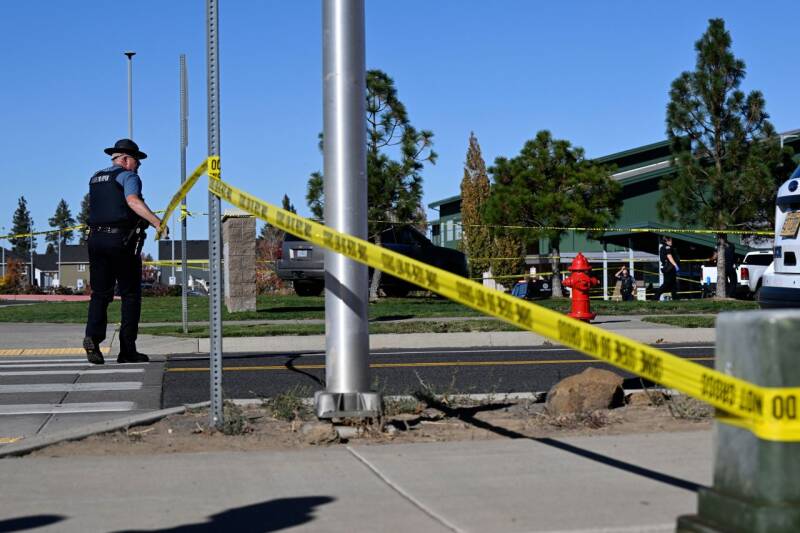
On a Thursday that should have been ordinary, an elementary school became the center of another American tragedy.
This blog is an attempt to document what we know, honor who was lost, and think clearly about what we can do — as parents, teachers, neighbors, and as a country — to stop school shootings.
The Events
On Thursday, October 15, 2026, just after 1 p.m. PST, a 16-year-old entered Silver Rail Elementary School in Bend, Oregon.
According to police, the shooter forced his way in by shooting through locked doors. He was identified Friday as John J. Griffin.
Inside, he killed four people: three children — ages 5, 8, and 11 — and one teacher. The New York Post reported it was picture day at the school.
The shooting ended quickly. Police said the shooter was found dead inside the school minutes after the shooting was first reported, and initial reports indicate he was stopped by an armed bystander — believed to be a student's father — who rushed into the building before police arrived.
At least two other people — a 7-year-old student and a 54-year-old teacher — were taken away by ambulance in critical condition.
The Aftermath
The scene in Bend was immediate chaos followed by profound silence. Police tape outside Silver Rail, parents running toward the school, then waiting for hours to be reunited. Two ambulances. A small community of about 100,000 people suddenly on every national news feed.
Bend Police Chief Mike Krantz held a news conference Thursday evening confirming the deaths. By late Thursday, national outlets including CNN, CBS News, and Reuters were reporting 3 children and 1 adult killed.
As of this morning, the investigation is still underway. Authorities are looking into how a 16-year-old accessed a firearm, his motive, and the full timeline of security failures and heroic actions.
The Families
When we talk about school shootings in statistics, we lose the people.
A 5-year-old is in kindergarten. An 8-year-old is in second or third grade. An 11-year-old is finishing elementary school. These are kids who had picture day outfits picked out, who had lunchboxes and favorite stories.
Their families are now facing the impossible — notifications that never should happen, empty bedrooms, and a community grief that will last for years, not news cycles.
Families in these tragedies consistently describe two waves of pain: the immediate loss, and then the long aftermath — trauma, anniversaries, birthdays, siblings who are afraid to return to school, parents who become advocates because they don't want another family to feel what they feel.
The most respectful thing we can do is not turn them into symbols. Give them space, support the official family funds when they are verified, and listen when they choose to speak.
The Teachers
One teacher was killed. Another was critically injured.
Teachers in every school shooting face an impossible choice in seconds: lock the door, shield the kids, run toward danger. At Silver Rail, educators did what teachers across the country have been trained to do — protect their students.
This is the part of the story that often gets overlooked. Teachers did not sign up to be first responders, security officers, or human shields. Yet again and again, they are. After a shooting, they are also the ones who have to walk back into classrooms, help children process fear, and try to make school feel safe again.
If you know a teacher, check on them this week.
How We Must Stop School Shootings
There is no single cause, and there is no single solution that has stopped these tragedies on its own. If we are serious about stopping them, we have to be honest enough to look at every layer:
1. School security that actually works
This includes what failed and what worked in Bend: locked doors, which the shooter shot through, controlled entry, rapid alert systems, and the role of an armed adult on site. Many districts are now auditing door hardware, glass, communication systems, and response times with local law enforcement.
2. Early identification and intervention
In almost every case review, there were warning signs — social isolation, threats, writings, or behavior changes that were seen by peers or adults but not connected. Strengthening threat assessment teams, making it easier and less stigmatizing to report concerns, and ensuring follow-through are consistently recommended by researchers.
3. Mental health and youth support
Access to counselors, school psychologists, mentoring, and crisis services. Not as a slogan, but as staffed, funded positions with manageable caseloads. For teenagers in crisis, the window to intervene is often short.
4. Family and community responsibility for firearms
Federal data consistently shows most school shooters under 18 obtain firearms from home or relatives. Secure storage laws, education on safe storage, and holding adults accountable when minors access their weapons is a point of broad agreement.
5. The broader policy debate
This is where viewpoints diverge, and an honest blog has to name both:
Some advocates focus on restricting access to certain types of firearms and high-capacity magazines, expanding background checks, and red-flag laws designed to temporarily remove guns from people showing dangerous warning signs.
Other advocates focus on protecting schools as hardened targets, increasing the presence of trained school resource officers, allowing vetted and trained staff to be armed, strengthening the enforcement of existing laws, and addressing cultural drivers of violence.
Most Americans want the same outcome — children alive and safe at school — but disagree on the most effective and least harmful path to get there. Communities that make progress tend to pursue multiple strategies at once rather than betting everything on one.
What You Can Do
If this story made you feel helpless, you are not.
Learn your school district's safety plan. Attend a school board meeting.
Ask what your school does for anonymous reporting and threat assessment.
If you own firearms, audit your storage today. Lock, unloaded, ammunition separate.
Support local mental health resources — volunteer, donate, advocate for counselors.
Talk to your kids, not just about active shooter drills, but about being an upstander when a peer is in distress.
Bend, Oregon will be grieving for a long time. The best way to honor the three children and their teacher is to refuse to let this become just another headline we scroll past.
Add comment
Comments