

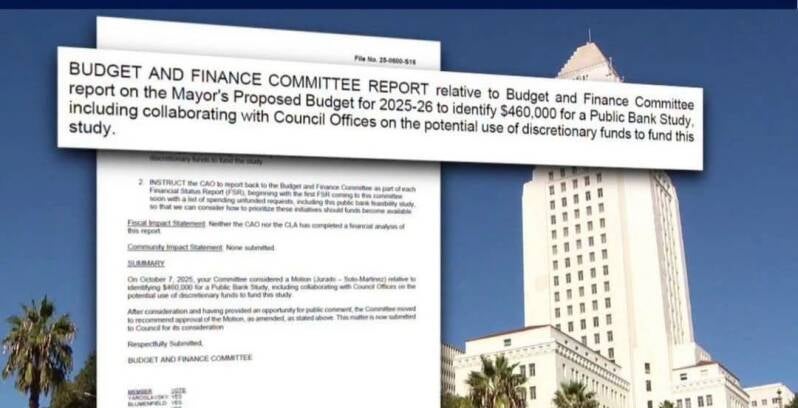
In a move that could reshape how public money is managed and invested in local communities, the Los Angeles City Council voted 11-3 to allocate $460,000 for a feasibility study examining the creation of a city-owned public bank. The decision marks a significant milestone in a years-long effort by advocates who believe a public bank could provide new financial tools to address some of the city's most pressing challenges, including affordable housing shortages, infrastructure needs, and access to capital for small businesses.
While the vote does not establish a public bank, it signals growing interest in exploring alternatives to the traditional banking system and determining whether such an institution could be financially viable and legally practical for one of America's largest cities.
What Is a Public Bank?
A public bank is a financial institution owned by a government entity rather than private shareholders. Unlike commercial banks that primarily seek profits for investors, a public bank is designed to serve public interests, with earnings potentially being reinvested into community priorities.
Supporters often point to the Bank of North Dakota, founded in 1919, as the most successful example of public banking in the United States. The bank works alongside local financial institutions and supports economic development, agriculture, infrastructure projects, and student lending programs.
The proposed Los Angeles public bank would not necessarily mirror North Dakota's model exactly, but the feasibility study is expected to examine various structures, governance systems, and potential areas of investment.
Why Los Angeles Is Considering a Public Bank
Los Angeles faces multiple economic and social challenges that require substantial long-term investment. Housing affordability has become a growing crisis, infrastructure improvements are expensive, and many small businesses continue to struggle with access to affordable credit.
Advocates argue that public funds currently deposited in private financial institutions could instead be leveraged through a city-owned bank to support local development goals.
According to supporters, a public bank could:
Expand Affordable Housing Financing
One of the most frequently cited benefits is the potential to increase financing for affordable housing projects.
Developers of affordable housing often face difficulties securing favorable financing terms. A public bank could potentially provide lower-cost loans or partner with community lenders to accelerate housing development.
With housing costs continuing to burden residents across Los Angeles, supporters believe public banking could become an important tool in addressing the city's housing shortage.
Strengthen Small Business Lending
Small businesses remain a cornerstone of Los Angeles' economy, yet many entrepreneurs struggle to obtain financing from large commercial banks.
A public bank could offer loan programs directly or work through local credit unions and community banks to expand lending opportunities. This could prove especially valuable in underserved neighborhoods where access to traditional financial services is often limited.
Supporters argue that locally focused lending could help create jobs, stimulate economic activity, and strengthen neighborhood business districts.
Invest in Infrastructure
Los Angeles faces enormous infrastructure demands, including transportation improvements, climate resilience projects, water systems, and public facilities.
A public bank could potentially help finance these projects through lower-cost borrowing mechanisms, reducing the city's dependence on Wall Street lenders and bond markets.
Proponents say keeping financing decisions closer to home could allow public investments to better align with local priorities.
Keep Public Money Local
Another central argument from advocates is that taxpayer dollars currently deposited with private financial institutions often support activities far removed from local needs.
A public bank, supporters contend, would keep more resources circulating within the Los Angeles economy, generating benefits that remain in local communities rather than flowing to distant shareholders.
What the Feasibility Study Will Examine
The newly approved study will analyze whether a public bank can realistically be established and sustained in Los Angeles.
Key questions are expected to include:
- Startup costs and funding requirements
- Regulatory and legal hurdles
- Governance and oversight structures
- Risk management systems
- Potential lending programs
- Partnerships with local financial institutions
- Long-term financial sustainability
- Economic benefits and potential drawbacks
The study will likely determine whether the concept can move from advocacy discussions to a practical financial institution capable of operating safely and effectively.
Supporters See a Transformational Opportunity
Public banking advocates view the council vote as more than a routine budget decision. For many, it represents progress toward a financial system that prioritizes community investment over private profit.
Supporters argue that local governments frequently face budget constraints while billions of dollars flow through traditional banks. They believe a public bank could allow Los Angeles to exercise greater control over those resources and direct capital toward projects that generate public value.
Many housing activists, labor groups, community organizations, and economic justice advocates have long campaigned for public banking as a way to address structural inequalities in access to capital.
Critics Urge Caution
Not everyone is convinced that a city-owned bank is the right solution.
Critics have raised concerns about financial risks, governance challenges, startup expenses, and the possibility of political influence over lending decisions. Some argue that banking is a highly regulated and specialized industry that requires substantial expertise and robust safeguards.
Others question whether a public bank would generate sufficient returns to justify the investment required to launch and maintain it.
For these reasons, many officials view the feasibility study as an essential first step before any final decision is made.
A National Conversation About Public Banking
Los Angeles is not alone in considering public banking. Cities and states across the country have explored similar proposals as policymakers search for new approaches to financing public priorities.
Growing concerns about housing affordability, infrastructure funding, economic inequality, and local economic development have renewed interest in public banking models. Although relatively uncommon in the United States, public banks are used in various forms around the world to support development and public investment.
The outcome of Los Angeles' study could influence similar discussions in other municipalities considering alternative financial strategies.
What Happens Next?
The approval of funding does not mean Los Angeles will immediately create a public bank. Instead, city officials and consultants will conduct a detailed examination of the concept's legal, financial, and operational feasibility.
Once completed, the study will provide policymakers with data and recommendations on whether moving forward makes sense.
If the findings are favorable, Los Angeles could take additional steps toward establishing a public financial institution. If significant obstacles emerge, city leaders may decide that the costs and risks outweigh the potential benefits.
Conclusion
The Los Angeles City Council's 11-3 vote to fund a $460,000 feasibility study reflects growing interest in rethinking how public money can be used to address local challenges. For supporters, a public bank offers a potentially transformative tool for financing affordable housing, empowering small businesses, investing in infrastructure, and keeping more capital circulating within the local economy.
Whether the idea ultimately becomes reality remains uncertain. What is clear, however, is that Los Angeles has taken a significant step toward exploring a new model of public finance, one that could have implications far beyond city limits and contribute to a broader national conversation about how governments can better leverage financial resources for the public good.
Add comment
Comments