

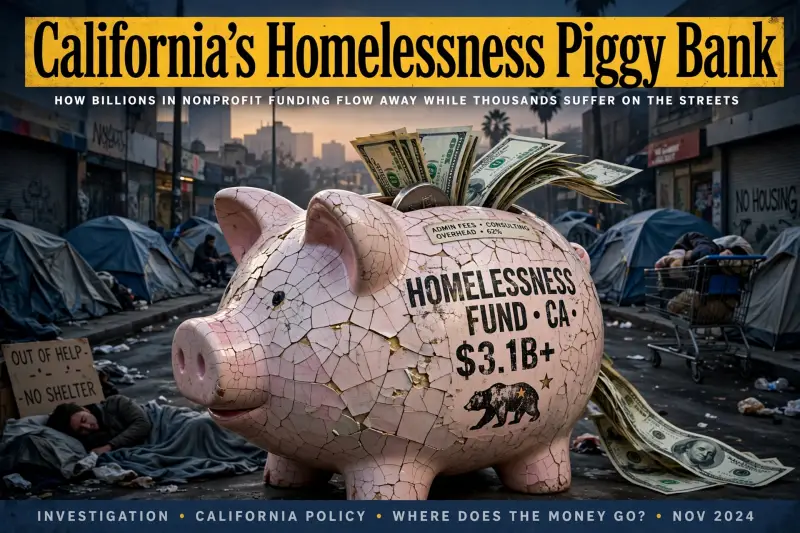
California spends more money on homelessness than any other state in America. Billions pour in every single year from Sacramento, from Washington, from city halls, from billionaire foundations, from private donors who genuinely want to help.
And yet, walk through Los Angeles, San Francisco, Oakland, San Diego, Sacramento, or Fresno and the tents are still there. The encampments are bigger. The people are sicker, older, more desperate. The numbers keep going up, not down.
That is not an accident. That is not a mystery. That is what happens when homelessness stops being a crisis to solve and becomes an industry to feed.
In California, homelessness has become a piggy bank. And the people living on the street are the ones paying for it with their health, their dignity, and sometimes their lives.
1. Follow the Money, Not the Mission
Every year, California announces another massive investment. A few billion here for housing. A few hundred million there for outreach. A new bond. A new tax. A new program with a hopeful acronym.
The press conferences are polished. The renderings are beautiful. The promises are huge.
Then the money disappears into a maze.
It goes to a county agency, which contracts it to a large nonprofit, which subcontracts it to three smaller nonprofits, which hire consultants to do a study, which hire another firm to do outreach, which hire case managers who are so burned out and underpaid they quit after six months.
By the time anything reaches a person sleeping under a freeway overpass, there is almost nothing left except a flyer, a bottle of water, and a clipboard asking the same intake questions they have answered twenty times before.
This is not charity. This is a supply chain. And every link in that chain takes a cut for administration, for overhead, for salaries, for rent, for marketing, for grant writers whose entire job is to win the next grant.
The bigger the crisis gets, the bigger the budgets get. The bigger the budgets get, the more jobs are created to manage the crisis. Nobody in that chain gets a raise for ending homelessness. They get a raise for managing it.
2. The Nonprofit Industrial Complex
Let's be clear about what we are talking about. There are good people doing hard work on the ground. There are outreach workers who truly care, shelter staff who show up on night shifts, volunteers who bring food and socks and blankets.
But the system they work inside is not built to end homelessness. It is built to sustain itself.
In California, you have hundreds of nonprofits competing for the same pot of government money. To win that money, they have to prove need. Need means more homeless people, more encampments, more overdose deaths, more mental health crises. If the numbers go down, the justification for the next grant goes down with them.
So the incentive is completely backwards. Success is punished. Failure is rewarded.
A nonprofit that actually cleared an encampment by getting every single person into stable, long term housing would be a hero for a week. Then it would have a problem. What does it do next year when its caseload is smaller? How does it justify the same staff, the same office, the same six figure executive salaries?
An organization that keeps the numbers high, that keeps producing reports about how bad things are, that keeps asking for more time and more money, never has that problem. It always has a reason to exist.
That is why we get endless pilot programs, endless task forces, endless counts, endless dashboards, and endless conferences about homelessness. Conferences held in nice hotels. With catered lunches. Where people in suits talk about people in tents.
3. The Salaries at the Top, the Scraps at the Bottom
Look at where the money actually lands.
At the top, you have CEOs and executive directors making $250,000, $350,000, $500,000 a year or more to run homelessness nonprofits. You have layers of vice presidents, directors of development, directors of communications, directors of policy. You have consultants charging thousands a day to tell the city what it already knows.
At the bottom, you have the actual frontline workers making barely above minimum wage, carrying caseloads of 40 or 50 people, with no real power to actually house anyone. They cannot offer a person an apartment. They can offer a referral. They can offer a waitlist. They can offer a shelter bed for one night if one happens to be open, if the person can get there, if they are willing to leave their partner, their dog, their belongings, and their dignity at the door.
And the homeless person? They get a hygiene kit. They get a survey. They get told to call 211. They get told to wait.
Imagine being in crisis, being sick, being addicted, being traumatized, being 68 years old and sleeping on concrete, and your entire interaction with a multi billion dollar system is a stranger with a clipboard telling you to be patient.
That is not help. That is theater. And it is theater paid for with public money.
4. Why Solving It Would Kill the Business
If California actually solved homelessness, thousands of jobs would disappear overnight. Whole departments would close. Whole nonprofits would have no reason to exist. Whole political careers built on promising to fix homelessness would have nothing to campaign on.
So the system protects itself by redefining success.
Success is no longer: How many people are permanently housed and still housed a year later?
Success is now: How many people did we contact? How many outreach encounters did we log? How many beds did we fund? How many meetings did we hold? How many reports did we publish?
You can log 10,000 outreach encounters and still have the same 10,000 people sleeping outside. You can fund 1,000 shelter beds and still have 5,000 people with nowhere to go. You can spend $100 million and still point to activity as proof that you are doing something.
Meanwhile, the housing that does get built is a scandal on its own. A single unit of so called affordable supportive housing in Los Angeles or San Francisco can cost $700,000, $800,000, even over $1 million to build. It takes five, seven, ten years to finish because of lawsuits, permitting, community opposition, and layers of fees to developers, architects, lawyers, and consultants.
By the time the building opens, the people it was supposed to help are dead, in jail, in the hospital, or moved three cities away. And the nonprofit that developed it gets to cut a ribbon and apply for the next project.
This is not incompetence. This is a business model. Slow, expensive, complicated housing is profitable for everyone except the homeless person waiting for it.
5. What Suffering Actually Looks Like
While the money moves, people are living and dying in conditions that should shame the richest state in the richest country on earth.
It looks like a veteran who served his country sleeping in a tent that floods every time it rains, because the shelter that was promised is full and the VA paperwork is stuck.
It looks like a mother with two kids living in her car, driving in circles all night because she is terrified of parking in one place too long, while she waits months for a voucher that never comes.
It looks like a 19 year old who aged out of foster care, with no family, no job, no ID, no phone charger, getting told to fill out an online application for housing on a phone with no data.
It looks like an elderly woman with diabetes, with swollen legs and no insulin, being swept from her encampment with 15 minutes notice, losing her medication, her tent, her photos, her birth certificate, everything she owned, because the city needed to clear the sidewalk for a press event.
It looks like people with severe mental illness and addiction being cycled through ERs, jails, and the street, over and over, because there is no long term treatment bed, no psychiatric hold that actually leads to care, no recovery program that does not have a six month waitlist.
And after every sweep, after every lost tent, after every missed appointment because they had no bus fare, they get blamed for not engaging with services. As if the services were actually there. As if they were actually designed for a human being in crisis, not for a grant report.
6. The Services Are Designed for Funders, Not for People
Go try to get help if you are homeless in California and see what you run into.
You have to prove you are homeless enough. You have to have the right documents. You have to be in the right county. You have to be sober enough, or sick enough, or veteran enough, or disabled enough to fit into a specific funding category. If you do not fit neatly into a box, you do not exist to the system.
You cannot bring your partner. You cannot bring your pet. You cannot bring your stuff. You have to follow curfews, rules, and mandatory classes. You have to be grateful. You have to tell your trauma story over and over to strangers to prove you deserve a bed.
Shelters close during the day. They kick you out at 6 a.m. They do not have storage. They do not have privacy. They do not have safety. Many women would rather sleep in a tent than in a shelter where they feel less safe.
And if you do get into a program, you are at the mercy of a case manager who may change three times in three months. Your file gets lost. Your voucher expires. Your appointment gets rescheduled. You start over.
No one who designed this system has ever tried to live inside it. If they had, they would know that a person in survival mode cannot navigate a bureaucracy designed by people with offices, assistants, and health insurance.
7. What Would Actually Help, and Why It Is Ignored
The solutions are not mysterious. They are just not profitable.
Direct cash to people on the street works, but there is no nonprofit that can take a 30 percent administrative cut from handing someone $500.
Simple, fast, low barrier shelter works, tiny homes, safe parking lots, motel conversions with no curfew and no sobriety test at the door. But those do not generate glossy architectural renderings and decade long development deals.
Mental health treatment and addiction recovery on demand works, beds available the same night someone asks for help, not six months later. But treatment does not pay as well as endless outreach and case management that never leads to treatment.
Building cheap, basic, permanent housing fast works. But cheap and fast does not create jobs for consultants, lawyers, and developers who make their living from expensive and slow.
The system ignores simple solutions because simple solutions do not need a massive system. A massive system needs complicated problems. So it keeps the problems complicated.
8. The Real Cost
Every dollar that goes to a bloated nonprofit that produces reports instead of housing is a dollar that does not go to a person who needs a roof.
Every year we delay real housing is another year people get sicker on the street. Another year of infections, of amputations, of overdoses, of assaults, of deaths that were preventable.
California does not have a homelessness problem because it lacks money, or compassion, or knowledge. California has a homelessness problem because homelessness has become too valuable to too many people to actually end.
The tents are not a failure of the system. The tents are the product of the system. They are the visible proof that justifies the next budget, the next grant, the next contract, the next job.
Until we change who gets paid and for what, nothing will change. Until funding is tied to real, permanent outcomes, people housed and still housed a year later, two years later, five years later, and not to activities and encounters, the piggy bank will keep getting filled.
And the people it was supposed to help will keep paying the price, with their bodies, with their futures, and with their lives.
It is time to stop asking how much more money we need to spend on homelessness. It is time to start asking where the money we already spent went, who got rich from it, and why the people it was meant for are still sleeping outside.
Add comment
Comments