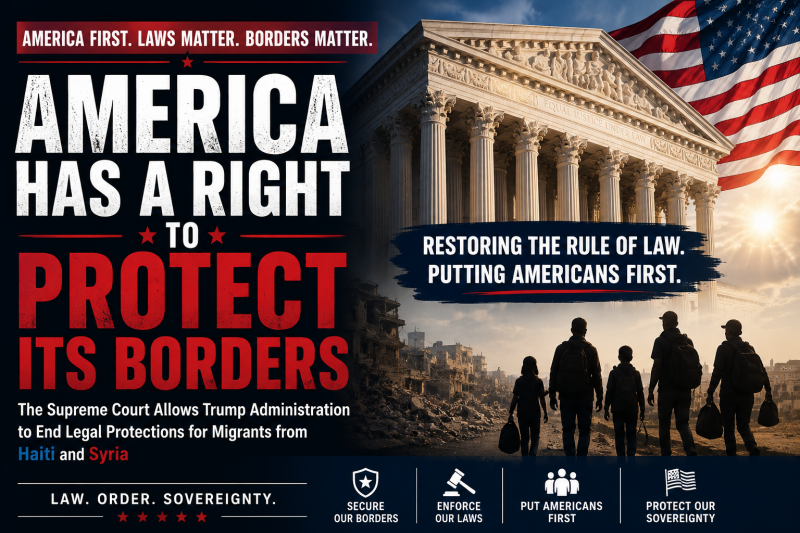
There comes a time when America has to stop apologizing for enforcing its own laws.
The Supreme Court’s decision allowing the Trump administration to end legal protections for certain migrants from Haiti and Syria has once again exposed one of the biggest battles in this country: whether America is still allowed to put its own citizens, its own laws, and its own national security first.
For too long, politicians in Washington have used immigration as a political game. They create temporary programs, extend them for years, refuse to fix the system, and then blame anyone who tries to bring order back to the process.
That is exactly what happened with Temporary Protected Status, also known as TPS.
TPS was never meant to be permanent. It was created as a temporary protection for people whose home countries were facing war, violence, natural disaster, or serious instability. The key word is temporary.
But in Washington, temporary often turns into forever.
And when leaders finally try to restore the original meaning of the law, the same people who ignored the problem for years suddenly act shocked.
Let’s be honest: America is a compassionate nation. We have helped more people than any country on earth. We have opened our doors, given people jobs, allowed families to rebuild, and offered protection during times of crisis.
But compassion does not mean chaos.
Compassion does not mean ignoring the law.
Compassion does not mean every temporary program becomes a permanent immigration status.
The Trump administration’s position is simple: America must have a lawful immigration system. The executive branch must be allowed to review country conditions, determine whether TPS still applies, and make decisions based on national interest, public safety, and the rule of law.
That should not be controversial.
Every nation has the right to decide who enters, who stays, and under what conditions. Without that right, there is no real border. Without a border, there is no real country.
Now, critics will say this decision is cruel. They will say people from Haiti and Syria are being forced back into hardship. They will say this is unfair to families who have been here for years.
Those concerns should be heard. Nobody should celebrate human suffering. Haiti and Syria have both faced serious problems. Haiti has dealt with violence, instability, poverty, natural disasters, and gang control. Syria has suffered through war, displacement, and destruction.
But America cannot be expected to carry every crisis in the world forever.
At some point, our leaders have to ask: What about American workers? What about American families? What about housing costs, schools, hospitals, public safety, wages, and local communities already stretched thin?
For years, working-class Americans have been told to be quiet while politicians protect every interest except their own. They are told there is always money, room, and resources for everyone else, but when they ask for safer streets, lower costs, better jobs, or stronger borders, they are called hateful.
That needs to end.
Wanting secure borders is not hateful.
Wanting immigration laws enforced is not racist.
Wanting America to put Americans first is not extreme.
It is common sense.
The real failure here is not the Supreme Court. The real failure is Congress. Congress has refused to do its job for decades. Instead of creating a clear, fair, lawful immigration system, Congress has allowed temporary programs, court fights, executive orders, and political battles to replace real leadership.
That is why families end up trapped in uncertainty. That is why employers get confused. That is why communities feel overwhelmed. That is why every administration ends up fighting the same immigration war over and over again.
America needs immigration reform, but it must be reform built on law and order.
That means:
America must secure the border.
America must know who is entering the country.
America must end abuse of temporary programs.
America must protect American jobs and wages.
America must remove people who have no legal right to remain.
America must also treat people with dignity while enforcing the law.
Those things can all be true at the same time.
We can care about people from Haiti and Syria while still saying TPS cannot last forever.
We can recognize hardship overseas while still saying America’s first duty is to its own citizens.
We can support legal immigration while rejecting endless temporary status that becomes permanent by political pressure.
The Supreme Court’s decision is a reminder that laws still matter. It is a reminder that the executive branch has authority to enforce immigration policy. It is a reminder that courts should not be used to block every attempt to restore order.
This is bigger than one case.
This is about whether America will continue down the road of open-ended immigration policies, or whether we will return to a system based on law, fairness, strength, and national sovereignty.
The American people are tired of being ignored.
They are tired of leaders who care more about global problems than local neighborhoods.
They are tired of being called heartless for wanting their country protected.
They are tired of watching temporary programs become permanent while Washington refuses to fix the real problem.
America can be generous, but America must also be strong.
America can show compassion, but America must also have borders.
America can help people in crisis, but America cannot become the permanent solution for every broken government, every failed state, and every disaster around the world.
The message should be clear:
We are a nation of laws.
We are a nation with borders.
We are a nation that must put its own people first.
And if Washington refuses to do that, then the American people will demand leaders who will.
Add comment
Comments