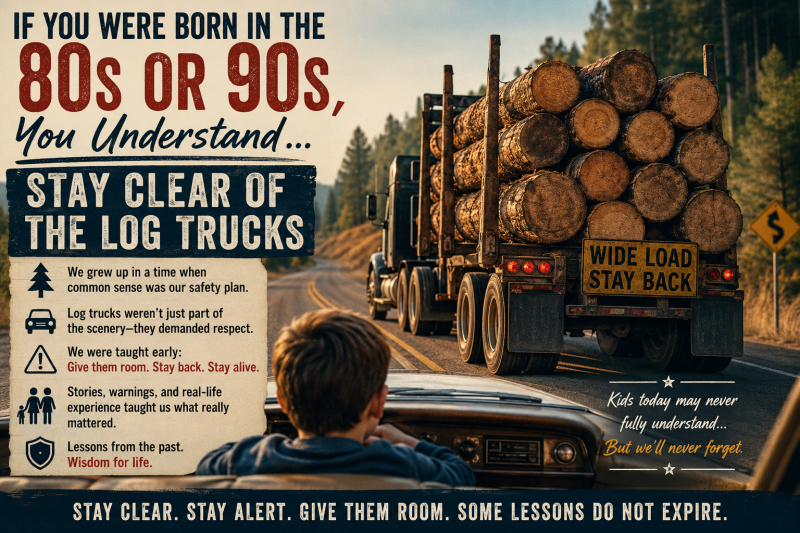
There are certain things you do not have to explain to people who were born in the 80s or 90s. We grew up in a different kind of world. A world where we played outside until the streetlights came on, drank water from the water hose, rode bikes without checking in every five minutes, and learned common sense not from a screen, but from life itself.
And one lesson that many of us learned early was simple:
Stay clear of the log trucks.
Now, if you were born in the 80s or 90s, especially if you grew up in the South, near country roads, highways, mill towns, wooded areas, or rural communities, you already know exactly what I am talking about. You did not need a public safety announcement. You did not need a viral video. You did not need someone on the internet explaining the danger.
You saw one log truck rolling down the road, stacked high with timber, chains holding everything together, bark flying off in the wind, and you knew one thing for sure: give that truck some room.
A lot of kids today will never fully understand that feeling. They might see a log truck and think it is just another big truck on the road. They may not understand the way your parents, grandparents, uncles, or older cousins would instantly get serious when one came near. The whole car ride could be calm, music playing, people talking, and then suddenly someone would say, “Back up off that truck.”
And nobody argued.
Because we knew.
There was something about those trucks that demanded respect. They looked powerful, heavy, and unpredictable. They carried trees that were bigger than most people’s cars. Those logs were not neatly packed little boxes. They were massive pieces of timber, round, rough, and heavy enough to destroy anything in their path if something went wrong.
When you were a kid sitting in the back seat, looking through the windshield, those logs seemed larger than life. You could see them shifting slightly as the truck moved over bumps in the road. You could see the straps and chains holding them down. You could see sawdust, dirt, and pieces of bark falling behind them. And every adult in the car knew better than to ride too close.
That was one of those old-school driving rules that came from experience. It was not written on a chalkboard. It was not something people made dramatic speeches about. It was just understood.
Do not tailgate a log truck.
Do not ride beside a log truck longer than you have to.
Do not get boxed in behind one if you can avoid it.
And if you are behind one on the highway, keep your distance and pay attention.
For many of us, that lesson came from stories. Every family had one. Somebody knew somebody who saw something happen. Somebody’s neighbor had a close call. Somebody’s cousin’s friend was driving behind a logging truck when a log shifted. Maybe the story changed depending on who told it, but the message was always the same: those trucks are nothing to play with.
And honestly, that was how a lot of lessons were passed down back then. The adults did not always explain things in a soft, careful way. Sometimes they just said, “Don’t do that unless you want to get hurt.” And somehow, we understood.
We grew up in a time when danger was not hidden from us. We saw it. We heard about it. We were taught to respect it. We knew roads could be dangerous. We knew machines could be dangerous. We knew trains, trucks, tractors, and heavy equipment were not toys. We knew there were some things you just did not play around with.
That is one of the biggest differences between then and now.
Kids today have so much information, but sometimes less common-sense exposure. They can look up anything on a phone. They can watch videos from all over the world. They can learn about safety from apps, school programs, and online guides. But some things are learned differently when you grow up seeing them in real life.
When you grew up around log trucks, you learned respect for weight, speed, and distance. You learned that just because something is on the road does not mean it is harmless. You learned that a vehicle carrying a heavy load is not the same as a regular car. You learned that what is tied down can still become dangerous if something breaks, shifts, or fails.
And that lesson stuck with us.
Even now, many of us who grew up in the 80s or 90s still feel that old instinct kick in. You can be grown, driving your own car, paying your own bills, living your own life, and the moment you see a log truck ahead of you, something in your mind says, “Nope. Not riding behind that.”
That is not fear. That is wisdom.
That is memory.
That is old-school survival sense.
There is a certain kind of awareness that came with growing up back then. We did not have backup cameras, lane assist, automatic braking, or phones telling us every road hazard ahead. We had eyes, ears, and adults who taught us to pay attention.
If a truck had a wide load, you moved over.
If a tractor was coming down a backroad, you slowed down.
If a train crossing started flashing, you stopped.
If a log truck pulled out in front of you, you gave it space.
It was not complicated. It was common sense.
And the funny thing is, a lot of those lessons were taught in the middle of regular life. You could be on the way to school, church, the grocery store, or your grandma’s house, and suddenly there was a life lesson right in front of you.
“See that truck? Stay back from it.”
That was the whole lesson. Short, direct, and unforgettable.
For those of us born in the 80s and 90s, log trucks became one of those symbols of growing up. They remind us of two-lane roads, pine trees, small towns, old highways, and long rides with family. They remind us of being kids in the back seat, watching the world go by through a window. They remind us of adults who may not have had fancy words, but knew how to keep us alive.
And they remind us that some fears were not silly. Some fears were protection.
It is easy for younger generations to laugh at the things we were warned about. They may not understand why we are cautious around certain things. They may think we are being dramatic when we tell them to stay back from trucks carrying logs, pipes, equipment, or anything heavy and unsecured-looking.
But we are not being dramatic.
We just remember.
We remember a world where you had to pay attention. We remember adults who drove with one hand on the wheel and one eye on everything around them. We remember riding in cars before every child had a tablet in their lap. We looked out the window. We noticed things. We learned roads, neighborhoods, shortcuts, warning signs, and danger signs.
And yes, we learned to stay clear of log trucks.
There is also something deeper in this conversation. It is not just about trucks. It is about how a whole generation learned caution. We were raised in a time where people expected you to understand that actions had consequences. You were taught that the world was beautiful, but it was not always safe. You were taught to think ahead, to watch your surroundings, and to listen when someone older told you something mattered.
That kind of teaching stays with you.
The world has changed. Roads have changed. Trucks have changed. Safety standards have improved. Technology has improved. But wisdom is still wisdom. Heavy loads still deserve space. Big trucks still need respect. And drivers still need to pay attention.
So when we say, “Stay clear of the log trucks,” we are not just repeating an old saying. We are passing down a piece of life experience.
We are saying, “Do not get too comfortable around danger.”
We are saying, “Give yourself room to react.”
We are saying, “Just because nothing has happened yet does not mean nothing can happen.”
We are saying, “Respect what can hurt you.”
That is a message kids today still need, even if they hear it in a different way.
Because every generation has its own version of the log truck. Every generation has something they need to be warned about. For us, it may have been those timber trucks rolling down the highway, loaded high and moving fast. For kids today, it may be distracted driving, phones, social media, online strangers, or cars that make them feel safer than they really are.
The lesson is the same.
Pay attention.
Respect danger.
Listen to wisdom.
And do not assume you are untouchable.
The truth is, people born in the 80s and 90s carry a lot of these little lessons with us. We laugh about them now, but they shaped us. We learned not to run on wet concrete. We learned not to touch a stove after being told it was hot. We learned not to ride our bikes too close to the road. We learned not to mess with stray dogs. We learned not to stand under trees during a storm. We learned that when an adult said, “Move,” you moved first and asked questions later.
And somewhere in that list is one lesson that still lives rent-free in our minds:
Do not ride behind a log truck.
Maybe that sounds simple. Maybe it sounds old-fashioned. But simple wisdom has saved a lot of lives.
So yes, if you were born in the 80s or 90s, you understand. You understand the look of those trucks. You understand the feeling of being behind one. You understand why adults told us to stay back. You understand why, even now, we change lanes, slow down, or give extra room when we see one.
Kids today may never fully understand it the way we did. They may never know that quiet fear mixed with respect. They may never sit in the back seat of an old car on a two-lane road, staring at a load of logs and wondering if those chains were strong enough.
But those of us who know, know.
We were raised with real-world warnings, backroad wisdom, and a healthy respect for things bigger than us.
And when it comes to log trucks, the rule still stands:
Stay clear, stay alert, and give them plenty of room.
Because some lessons do not expire.
Add comment
Comments