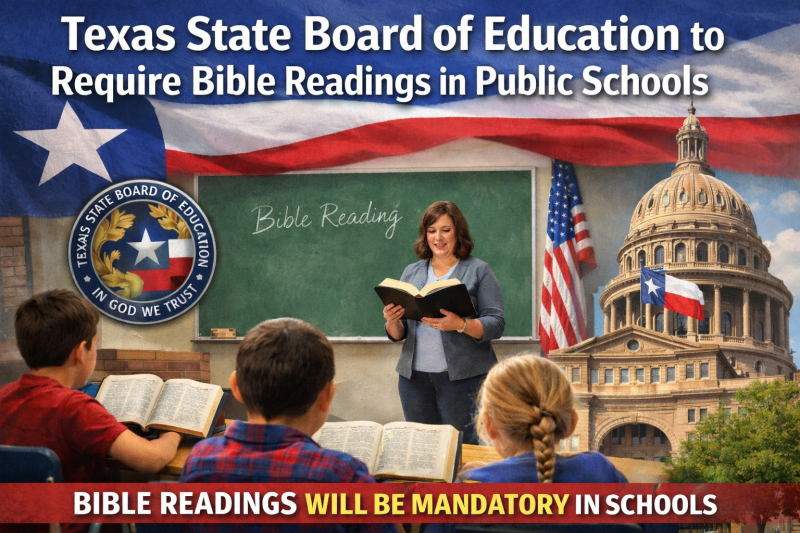
I may get heat for this, but I genuinely do not care.
As someone with a Divinity Degree, I feel a responsibility to speak clearly, calmly, and theologically about Texas’ new law requiring public schools to incorporate Bible reading into classroom instruction. The public reaction—especially from people who openly identify as Christians—has been surprising, contradictory, and in many cases, deeply revealing.
Before we address the hypocrisy, let’s first understand what the law actually does.
📘 What the Texas Law Requires
The new Texas legislation mandates that public schools include foundational religious texts, including the Bible, as part of their curriculum. The law frames the Bible as a historical, literary, and cultural document, not a devotional one. Teachers are instructed to present Scripture academically—meaning:
-
No preaching
-
No proselytizing
-
No religious coercion
-
No requirement for students to adopt any belief
Instead, the Bible is treated as a primary source that has shaped Western civilization, literature, ethics, political thought, and social development.
This is not unprecedented. The U.S. Supreme Court has long affirmed that the Bible may be studied in public schools for its literary and historical value, as long as it is not used for religious indoctrination. Texas’ law simply formalizes this academic approach.
Whether someone agrees or disagrees with the policy is a matter of personal opinion, and individuals should always confirm details with trusted sources. But the law itself is clear: it is about education, not evangelism.
✝️ The Theological Contradiction
Now here is where the tension emerges.
Many people who publicly identify as Christians are outraged by this law. They argue that Scripture does not belong in the classroom, that it is inappropriate, or that it crosses a boundary. But from a theological standpoint, this reaction is baffling.
Christianity is not a cultural label—it is a faith built entirely upon Scripture.
The Bible is not optional reading material. It is the foundation of Christian doctrine, ethics, spiritual formation, and identity. It is the text through which Christians understand God, Christ, salvation, morality, and purpose.
So when Christians become angry at the idea of students reading the Bible—even academically—the contradiction is glaring.
If you claim Christ, you are claiming a life shaped by Scripture. If you claim Christianity, you are claiming a worldview informed by biblical narrative and theology. If you claim the Bible as sacred, why would its presence in a classroom offend you?
This is not persecution. This is not oppression. This is hypocrisy.
📚 Identity Without Formation
From a Divinity scholar’s perspective, the reaction to this law exposes a deeper spiritual issue: many people want the identity of Christianity without the discipline of Christianity.
They want the comfort of the title without the responsibility of engagement. They want the symbolism without the Scripture. They want the cross without the text that explains it.
But Christianity has never been a faith built on symbols alone. It is a faith built on revelation—revelation preserved in the Bible.
You cannot claim the faith and reject the formation. You cannot claim the identity and reject the instruction. You cannot claim Christ and reject the text that reveals Him.
📝 So What Does This Mean?
Whether someone supports or opposes Texas’ policy is a separate matter. But if a person calls themselves a Christian and is offended by the presence of Scripture in an academic environment, the issue is not the law.
The issue is their own theological inconsistency.
And that is why the reaction is hypocritical.
Add comment
Comments