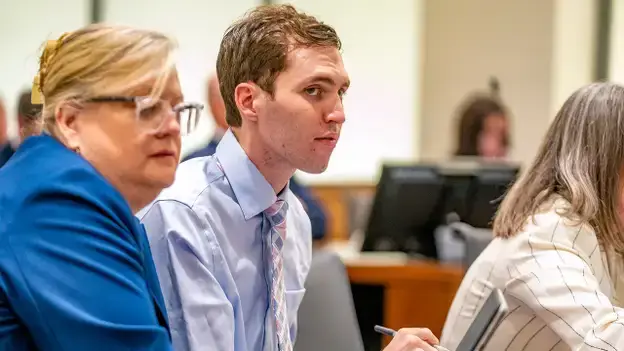
The preliminary hearing for Tyler Robinson, the man accused of assassinating Turning Point USA founder Charlie Kirk, has turned into a tense and emotional weeklong courtroom drama. What was expected to be a procedural step has instead revealed a detailed timeline, new evidence, and raw grief from the Kirk family.
Investigators testified that Robinson visited the Utah Valley University campus four separate times on the day of the shooting. According to Agent David Hull, Robinson was seen on campus before the shooting, at the time of the shooting, and again later that night. Surveillance footage allowed authorities to track his movements, creating a picture of repeated, deliberate presence.
Prosecutors also introduced multiple TPUSA videos showing different angles of the shooting. These videos weren’t played in open court but were handed to the judge and Robinson’s attorney, signaling that visual evidence may become a central part of the case.
Hull described the immediate aftermath of the shooting as “organized chaos.” When he first learned Kirk had been shot, there was uncertainty about whether an active shooter was still on campus. Once the scene was secured, investigators focused on identifying who was involved.
There were moments of unexpected levity amid the tension. Defense attorney Richard Novak laughed when Judge Tony Graf announced that cameras would not be allowed in the courtroom. Novak later explained that the media request for still photography had simply been submitted too late, saying, “Well, you gotta do things on time.”
The emotional weight of the hearing was unmistakable. Charlie Kirk’s widow, Erika, quietly left the courtroom when a former UVU officer described the fatal gunshot. She kept her head down throughout the testimony, while someone walking with her was seen crying. Earlier that morning, the family released a statement describing each court proceeding as a painful reminder of their loss and asking for privacy as they continue to navigate their grief.
Former UVU officer Chris Bagley delivered some of the most striking testimony. He described a disturbed patch of gravel atop the Losee Center — what he called a “sniper pad.” He said it looked like markings from elbows, knees, and feet, positioned in a direct line of sight toward the courtyard where Kirk was speaking. Bagley also confirmed that the rooftop offered a clear view of the tent where Kirk stood, reinforcing prosecutors’ theory of a calculated long-distance shot.
This preliminary hearing is unusually public. Robinson was charged by information rather than through a grand jury, meaning prosecutors must establish probable cause in open court before the case can move to trial. The burden of proof is lower than at trial; prosecutors do not need to prove guilt beyond a reasonable doubt at this stage, only that the evidence supports moving forward.
As the hearing continues, the courtroom remains a focal point for supporters, critics, and observers nationwide. The evidence is stacking up, emotions are running high, and the legal battle over one of the most shocking political killings in recent memory is only beginning.
Add comment
Comments