

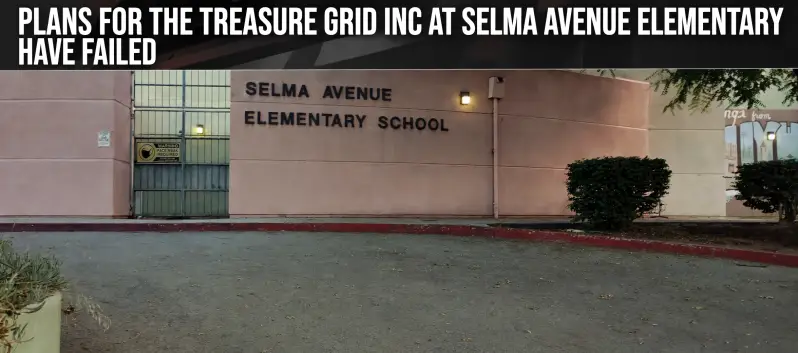
After months of planning and community conversations, the effort to bring The Treasure Grid Inc to the old Selma Avenue Elementary School building is over.
Kerry B. Lewis, founder of The Treasure Grid Inc, confirmed in a statement this week that the project will not move forward at that location. His business partner, Joshua Byrd, said the pair are not giving up on the larger vision, only on that particular site.
The news marks a sharp turn for a proposal that many neighbors had been watching closely. The idea was to transform the old school space into a working community hub, anchored by a free after school program and a list of services designed to serve families, youth, and creatives under one roof.
The Plan for Selma Avenue
The pitch was simple in concept and ambitious in practice.
Lewis and Byrd wanted to repurpose the old Selma Avenue Elementary School building, a familiar neighborhood landmark that has long carried history for families in the area, into a new home for The Treasure Grid Inc.
Rather than a single business or a single program, the building would have housed a collection of services. The founders described it as a grid, a connected network where each service could support the others. A young person could come for after school help and find mentorship. A parent could come for resources and find community. A creative could come for space and find collaboration.
At the center of it all was the promise of a FREE AFTER SCHOOL PROGRAM, a cornerstone the founders say has never been negotiable.
For Lewis and Byrd, Selma Avenue made sense because it was already built for learning, gathering, and youth. Classrooms could become program rooms. Common areas could become community space. A school that once served the neighborhood in one way could serve it again in another.
What Lewis Said in His Statement
In his statement, Lewis was direct about why the Selma Avenue plan failed.
He said the school board was not what he expected, and that he felt they would be hard to work with long term.
"The school board was not what I expected, and I felt they would be hard to work with long term."
Lewis did not frame the decision as a dispute over a single meeting or a single detail. He framed it as a question of fit for the future. A project like The Treasure Grid Inc, he argued, needs a partner who is aligned not just on a lease or a timeline, but on how to work with the community day after day, year after year.
If that foundation was not there at the start, he said, it was better to walk away now than to force a partnership that would struggle later.
The statement did not close the door on working with schools or public institutions in the future. It closed the door on this specific site, with this specific board, at this specific time.
Joshua Byrd: We Will Keep Looking
If Lewis delivered the hard news, Byrd delivered the next step.
Byrd said the team will keep looking.
"We will keep looking."
In his remarks, Byrd emphasized that the end of the Selma Avenue talks is not the end of The Treasure Grid Inc. The mission has not changed. The location has.
Byrd, who has worked alongside Lewis to build out the concept, said the partners remain committed to finding a space that can actually hold what they want to build. They are looking for a building, a landlord, and a neighborhood partnership that can grow with them, not work against them.
For supporters who had pinned their hopes on Selma Avenue specifically, Byrd's message was meant to be both honest and reassuring. The address is changing. The work is not.
What The Treasure Grid Inc Was Supposed to Be
At its core, The Treasure Grid Inc was never pitched as just one program.
Lewis and Byrd describe it as a hub that would house a list of services, all connected by a shared purpose: to give people, especially young people, access to tools, guidance, and opportunity without the usual barriers.
The free after school program was designed to be the entry point. It would offer a safe, consistent place for students after the bell, with homework support, enrichment, and mentorship built into the day. For many families, cost is the first barrier to after school care and enrichment. By making the program free, the founders wanted to remove that barrier entirely.
Around that anchor, the larger grid would expand. The founders envision services that support learning, creativity, wellness, and practical life skills, all in a space where a family does not have to travel across the city to find help.
The Selma Avenue building, with its classrooms, open spaces, and neighborhood footprint, felt like a natural fit for that model. It could have allowed the programs to live side by side, rather than scattered and disconnected.
Why This Loss Hits Differently
The failure of the Selma Avenue plan is not just about real estate.
For neighborhoods in Los Angeles, old school buildings carry memory. Parents remember drop offs. Students remember teachers. Neighbors remember community events. When a building like that sits underused, people start to imagine what it could become again.
That is part of why the proposal resonated. It was not about tearing something down or building something foreign. It was about restoring a familiar place to a familiar purpose: serving kids and families.
Lewis and Byrd tapped into that feeling. They talked about the building not as an empty property, but as a place that could work again.
That is also why the news of the failed plan has landed hard for some supporters. It is not just a business deal falling through. It feels like a missed chance to bring life back to a building that many people still care about.
What Comes Next
Both founders are clear about one thing. The Treasure Grid Inc is still coming.
The search for a new home is now underway. Lewis and Byrd say they are open to other school sites, community buildings, commercial spaces, and partnerships that can offer long term stability.
The criteria, based on Lewis's statement, are now clearer than ever. They are not just looking for square footage. They are looking for a partner who is easy to work with, aligned on community values, and committed for the long term.
That may mean a slower process. It may mean more meetings, more site visits, and more patience. But both men say it is worth it if it means the project launches on solid ground.
In the meantime, the founders say they will continue building out the programming, partnerships, and plans for the free after school program so that when the right building is found, they can move quickly.
A Setback, Not an Ending
In the world of community projects, not every good idea lands on the first try. Sometimes the building is wrong. Sometimes the timing is wrong. Sometimes the partnership is wrong.
Lewis and Byrd are treating Selma Avenue as one of those moments.
The plan for the old Selma Avenue Elementary School has failed. The statement from Lewis makes that clear. The commitment from Byrd makes the next part clear too. They will keep looking.
For families waiting on a free after school option, and for neighbors who wanted to see the old school building alive again, the message is to stay tuned. The Treasure Grid Inc has lost an address, but it has not lost its mission.
Updates on the new search and the launch timeline are expected in the coming weeks.
Add comment
Comments